Ayurvedic hair fall remedies that work. And what to do when the shower drain is still full.
Pulls a clump out of the comb. Looks at it. Looks at the shower drain. Looks at the pillow in the morning. Not again.
Hair fall is one of the most common complaints I see at the clinic, especially from women in their 30s and 40s, and increasingly from men in their late 20s. People come in exhausted, having tried castor oil masks on YouTube, biotin supplements from Amazon, rosemary spray, the “inversion method,” expensive dermatologist consultations that ended in “stress-related, try minoxidil.”
Here’s what actually works at home for most patterns of hair fall, why the oiling you’ve been doing may not be helping, and when clinical scalp therapies become the next step.
Why hair fall is almost never “just hair fall”
In Ayurveda, hair is considered a byproduct of asthi dhatu (bone tissue) and is directly linked to the quality of your nervous system, your digestion, your hormones, and specifically Pitta dosha. Chronic hair fall almost always traces back to one or more of:
- Chronic stress (burns the hair follicle at the root — this is Pitta aggravation)
- Poor digestion (asthi dhatu isn’t well-nourished)
- Hormonal shifts (thyroid, PCOS, perimenopause, postpartum)
- Vata aggravation (dryness, scalp tightness, breakage at the mid-shaft)
- Nutrient depletion (iron, B12, vitamin D, protein)
- Scalp inflammation (dandruff, seborrheic dermatitis, folliculitis)
Oiling can support scalp and hair wellness, but it works best when the oil and routine match the pattern behind the hair fall. If the main driver is stress, nutrition, hormonal change, scalp irritation, or another underlying factor, oiling alone may not be enough.
1. Weekly oiling, but with the right oil for your pattern
Not all hair fall is the same. The oil you use should match the pattern:
- Stress-driven hair fall (Pitta pattern): Thinning around the hairline and crown, scalp feels warm, often with early greying. Use Bhringaraj oil, Neelibhringadi oil, or coconut oil. Avoid heating oils like sesame or mustard.
- Dry scalp hair fall (Vata pattern): Scalp feels tight and flaky, hair breaks mid-shaft, lots of static, often with dandruff. Use sesame oil or Mahabhringaraj oil.
- Hormonal hair fall (postpartum, thyroid, PCOS): Diffuse thinning across the whole scalp. Use Bhringaraj, but also consult a practitioner — the oil is helping, but the underlying hormonal picture needs direct attention.
- Dandruff-related hair fall (Kapha-Pitta pattern): Oily scalp with flakes, itchy, hair fall is a consequence of chronic scalp inflammation. Use neem oil for a few weeks, then transition to Bhringaraj.
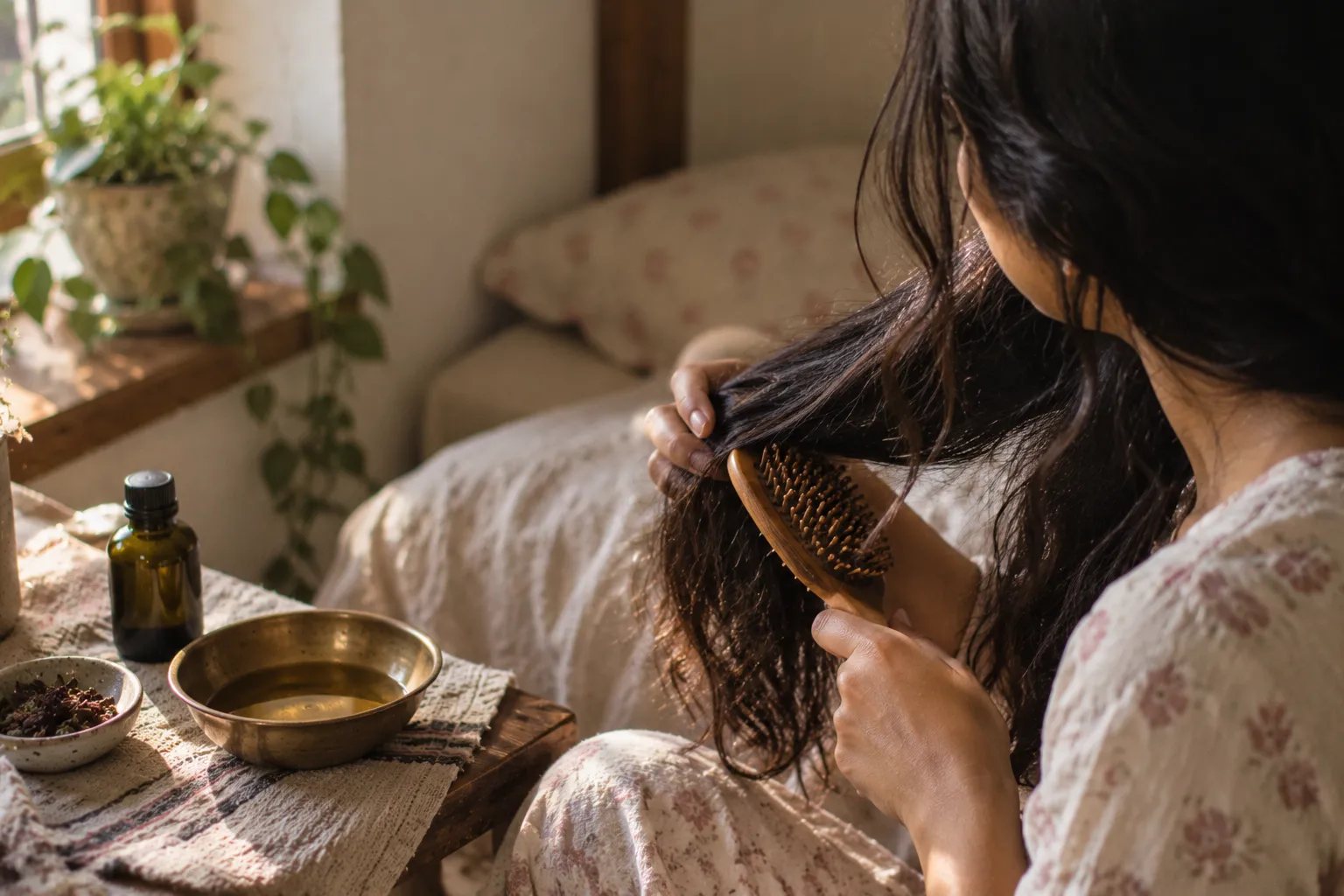
The oiling itself: warm the oil, massage into the scalp with the fingertips (not nails) for 10-15 minutes. Leave on for 2-4 hours, or overnight if your pillowcase allows. Wash out with a mild sulfate-free shampoo. Do this once a week, not every day. Over-oiling is a real thing — it can clog follicles and worsen hair fall in Kapha-type patterns.
2. Scalp massage, even without oil, for 5 minutes daily
The oiling matters. The massage matters more. Even on days you’re not oiling, a 5-minute dry scalp massage with your fingertips does several things that measurably support hair growth: increases blood flow to the follicles, releases tension in the scalp fascia (which, when chronically tight, restricts circulation), and settles the nervous system through the dense network of marma points on the scalp.
The $300 scalp massager from Amazon is unnecessary. Your own fingertips work better. Pressing in small circles, moving across the whole scalp, starting at the hairline and working back. 5 minutes. Daily.
3. Dietary shifts that support the hair follicle
Hair grows from the inside. The follicle needs specific nutrition to produce healthy strands:
- Adequate protein — most hair fall clients I see are under-eating protein. Target 0.8-1g per pound of body weight daily.
- Iron and B12 — if you’re vegetarian or vegan, get your levels checked. Deficiencies are extremely common and show up as hair fall before other symptoms.
- Healthy fats — ghee, avocado, nuts, seeds. The hair follicle needs lipids to produce healthy strands.
- Soaked almonds — 8-10 overnight-soaked almonds in the morning is a classical Ayurvedic practice for hair and skin.
- Amla (Indian gooseberry) — fresh, dried, powdered, or in a classical formulation. One of the most time-tested Ayurvedic foods for hair.
- Reduce caffeine, especially coffee on an empty stomach. Chronic caffeine aggravates Pitta and depletes adrenals, both of which show up in hair.
4. The sleep connection most people underestimate
Hair growth happens primarily during deep sleep. Chronic sleep deprivation and chronic late nights (past 11 PM) are two of the most consistent patterns I see in chronic hair fall clients. In Ayurveda, late nights specifically aggravate Pitta, which specifically affects hair.
In bed by 10 PM. Phone out of the bedroom. Cool, dark room. This isn’t a hair tip. It’s the most important hair tip. The follicle rebuilds while you sleep.
5. Stress is doing more damage than any single thing
Chronic nervous system activation increases cortisol, which directly disrupts the hair growth cycle. You can oil daily, eat perfectly, and still lose hair if your sympathetic nervous system is running your life.
What actually helps:
- Daily pranayama — 10 minutes of Nadi Shodhana (alternate nostril breathing) in the morning
- No screens for the first and last hour of your day
- A consistent evening wind-down routine
- Walking outdoors (not on a treadmill) at least 20 minutes a day
Soft recommendations. Hard impact over 3-4 months.
When home remedies have taken you as far as they can
For many patterns of hair fall — especially stress-related, mild postpartum, early perimenopausal, and nutritional — consistent home remedies produce visible improvement within 3-4 months. The hair follicle cycle is long, so results take time.
For chronic hair fall patterns that have been going on for a year or more, or hair fall driven by significant Pitta imbalance or chronic scalp inflammation, home remedies help but often don’t resolve. This is when the clinical ayurvedic solution for hair fall through dedicated scalp therapies becomes the next step.
Clinical scalp therapy: Shiroabhyanga
For persistent hair-fall patterns, Shiroabhyanga is the main clinical Ayurvedic scalp therapy we use at Ayurhitam alongside personalized diet, lifestyle, and home-care guidance.
Shiroabhyanga — the warm oil head massage
Shiroabhyanga is a 40-minute classical ayurvedic solution for hair loss that works through warm medicated oil massaged into the head, scalp, neck and shoulders. It’s $100 at the clinic. Done well, with the right oil chosen for your pattern, it does what home oiling can’t — the therapist’s hands reach pressure points at the base of the skull, along the hairline, and across the whole scalp with a specific marma sequence that releases long-held tension in the scalp fascia. The oil is warmer, worked in longer, and absorbed deeper than home practice typically achieves.
For hair fall, a series of 5-7 Shiroabhyanga sessions on consecutive weeks typically produces visible improvement in scalp health, often with reduced fall within 4-6 weeks.
Whether Shiroabhyanga is appropriate for your pattern is best decided during a consultation.
A realistic timeline
- Months 1-3: Home remedies. Weekly oiling, daily scalp massage, dietary changes, sleep, stress protocol.
- Month 3 check-in: If you’re seeing fewer hairs in the shower drain, the comb, and the pillow, keep going.
- Month 3 if not improving: Book a consultation. Start a Shiroabhyanga series if it is appropriate for your pattern.
- Months 4-6: Clinical series + continued home practices. Visible new growth starts around month 4 for most clients.
- Month 6+: Maintenance oiling, maintenance clinical sessions at seasonal transitions.
A note: Ayurhitam is an Ayurvedic wellness center with locations in Fremont and Sunnyvale, California. This article is for general education and is not a substitute for care from your doctor. Please don’t change prescribed medications without medical guidance. Statements have not been evaluated by the FDA.
Frequently Asked Questions
50-100 strands a day is normal. Anything consistently over that for more than a few weeks warrants attention.
Yes. Some clients continue minoxidil while doing Ayurvedic work. Others wean off as the Ayurvedic plan takes hold. Have the conversation with your dermatologist.
Hair cycles are slow. Expect visible reduction in fall at 2-3 months. Visible new growth at 4-6 months. Significant change at 9-12 months. Anyone promising faster results is probably selling you something.
Ayurhitam offers Shiroabhyanga as part of our Ayurvedic hair and scalp wellness support at our Fremont and Sunnyvale clinic locations. Call 510-556-3738 to book.
If home remedies aren’t moving the needle, book a consultation and we’ll figure out which pattern you’re actually dealing with and what the right therapy sequence is for you.
Hair fall that home remedies aren’t fixing? Book your consultation at Ayurhitam. Call 510-556-3738.