Move dinner before sunset and watch what shifts.
My grandmother used to say the stomach has its own clock.
She was right. Modern research is finally catching up with what Ayurvedic practitioners have been saying for 3,000 years: the time you eat matters at least as much as what you eat, and probably more.
For most of my Bay Area clients, this single shift — moving dinner earlier — produces faster, more visible results than any dietary change I prescribe. Better sleep. Clearer mornings. Easier digestion. Steadier energy. Sometimes weight that wouldn’t budge starts to move. I’m not exaggerating. This is boring, free, available to everyone, and it works.
Here’s the rule, why it works, and how to actually do it when you live in a city that eats dinner at 8:30 PM.
The rule, as simple as I can state it
Eat your dinner between 6 PM and 7 PM. Finish eating by 7:30 PM at the latest. Make dinner the lightest meal of the day, not the heaviest. Don’t eat anything after dinner.
That’s it. That’s the entire rule.
Why Ayurveda cares about this
Classical Ayurveda understands the body as running on three doshic cycles throughout the day. Kapha governs the slow, heavy, cool part of the morning (6-10 AM). Pitta governs the hot, metabolic middle (10 AM-2 PM). Vata governs the light, mobile late afternoon and night (2-6 PM, then 2-6 AM). These cycles aren’t abstract. They map to what’s actually happening in your digestion.
Agni, the digestive fire, is strongest at Pitta midday. This is why Ayurveda says lunch should be your biggest meal — your body is biologically ready to break it down. By 6 PM, Agni is weakening with the sun. By 8 PM, it’s much lower. By 10 PM, if you eat a heavy meal, your body has to pull energy from other systems (nervous system, immune, tissue repair) just to digest.
Modern chronobiology research says the same thing in different words. Late eating is associated with worse sleep quality, higher blood sugar, more inflammation, and disrupted circadian rhythm. The 3,000-year-old framework and the 2025 research agree. Eat with the sun.
What happens when you move dinner earlier
I’ve watched this pattern enough times to describe it in sequence.
Week 1: You feel strangely hungry at 6 PM, which hasn’t happened in years. You eat. You feel strangely hungry again at 10 PM, because your body is used to being fed then. You go to bed hungry. You hate this.
Week 2: The 10 PM hunger starts to shift. Your body is recalibrating. Sleep is slightly deeper. Mornings are slightly clearer.
Week 3: You wake up feeling actually hungry for breakfast, which also hasn’t happened in years. Digestion feels different — not necessarily dramatic, just noticeably more regular.
Week 4 onward: The 10 PM hunger is mostly gone. Your energy stabilizes through the afternoon. You start to notice you don’t actually want heavy food at 8 PM anymore. If you had any lower-grade digestive stuff going on (bloating, reflux, chronic fatigue in the afternoon), it’s probably noticeably better.
None of this is magic. It’s your body returning to the rhythm it was designed around.
What to actually eat for an early light dinner
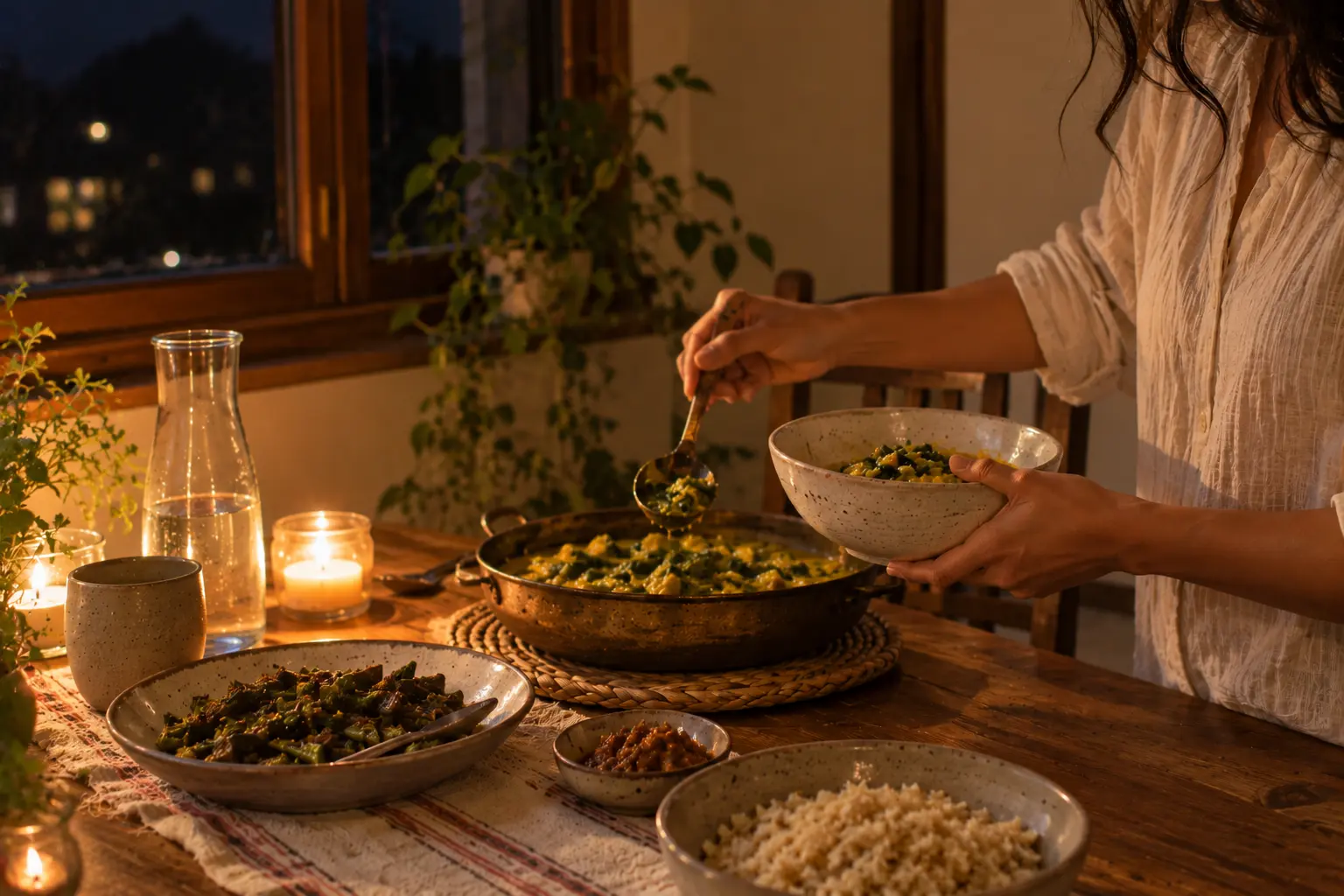
Warm. Cooked. Simple. Not a huge salad (raw greens are hard to digest when Agni is low). Not a protein-heavy slab of grilled meat (too dense for weak evening digestion). Not a cold grain bowl (both the cold and the raw hurt late-day digestion).
What actually works:
- A bowl of warm soup, dal, or kitchari
- Cooked vegetables with ghee and basmati rice
- A small portion of cooked fish or chicken with steamed vegetables and warm grains
- Vegetable khichdi, which is a one-pot meal of rice, mung dal, and vegetables that’s probably the single most Ayurvedic-friendly dinner in existence
- A warm vegetable curry with a small amount of rice
Portion-wise, dinner should be smaller than lunch. If lunch was two cupped-handfuls of food, dinner is one. The point isn’t restriction. The point is giving your Agni a reasonable workload at its weakest time.
How to do this when you live in the Bay Area
I know. Dinner reservations are at 8. Date night. The kids have soccer until 7. Your partner doesn’t get home until 7:30. The quarterly review ran late. Life.
A few things that help real clients make this work:
- Make lunch the main event. If dinner is going to be small, lunch has to be substantial. A proper cooked lunch at midday is the lever that makes everything else possible. If you’re currently eating a sad desk salad at 1 PM, you’re setting yourself up to be ravenous at 8.
- Prep one-pot dinners ahead. Kitchari takes 25 minutes and keeps for 3 days. A big pot of lentil soup on Sunday handles 4 dinners. The friction of “what’s for dinner” at 6:30 PM is often why dinner ends up being 9 PM takeout.
- Social dinner nights, let them be social dinner nights. If you’re going out on Friday, don’t torture yourself. Have the dinner. Eat lighter the next day. The point is a sustainable rhythm, not perfection.
- The kids-and-soccer problem is real. If evening practice means a 7:30 dinner is unavoidable, consider making it extra light (soup, warm rice, cooked vegetables, no protein) and sitting down for an actual meal at lunchtime. The lunch meal becomes the anchor.
- Don’t snack after dinner. This is the hardest piece for most people. The habit of “something sweet” or “a glass of wine and a few bites” after 9 PM is the one that most disrupts sleep and morning digestion. Even one week of not eating after dinner tends to shift sleep noticeably.
A note on fasting
Intermittent fasting (the kind where you skip breakfast and eat your first meal at noon) is popular in tech circles right now. From an Ayurvedic view, this is backwards for most constitutions. Skipping breakfast when Kapha is already heavy in the morning aggravates sluggishness. Eating late and skipping morning food runs the whole day against the natural doshic cycle.
A better version of fasting, if you want one: finish dinner by 7 PM, don’t eat again until 7 AM. That’s a 12-hour overnight fast that aligns with the body’s natural rhythm. You don’t need an app for it. You just stop eating at 7.
A note: Ayurhitam is an Ayurvedic wellness center with locations in Fremont and Sunnyvale, California. This article is for general education and is not a substitute for care from your doctor. Please don’t change prescribed medications without medical guidance. Statements have not been evaluated by the FDA.
Frequently Asked Questions
You will be, for the first week or two. Warm milk with a pinch of nutmeg or cardamom is the classical Ayurvedic answer if you absolutely need something. Mostly, just go to bed. The hunger passes and your body recalibrates within a few weeks.
Yes. Same food, eaten at 6 PM vs 10 PM, is processed by your body very differently. The 6 PM meal is digested while Agni is still active. The 10 PM meal sits half-digested in your gut overnight, generating ama (metabolic waste in Ayurvedic terms) that your body has to deal with the next day.
A piece of dessert at an early dinner is fine. The problem isn’t the food. The problem is late-night sweet snacks that happen 3 hours after dinner has already finished, which is a different pattern. Life includes dessert. Just eat it with your dinner, not instead of sleep.
Yes, significantly. Late eating is one of the biggest invisible drivers of poor sleep I see in Bay Area clients. If you’re working through chronic sleep issues, moving dinner earlier is often the single most effective lever before you even consider therapies like Shirodhara or herbal support.
Want help building a Dinacharya that includes your actual Bay Area evening schedule? Book an initial consultation at Ayurhitam. Call 510-556-3738.