You close your laptop after a long workday, but your body still seems to be holding the entire day.
Your shoulders remain lifted. Your jaw is tight. Your neck feels rigid, and you may not remember the last time you took a full, relaxed breath. Even after leaving the desk, your body does not immediately receive the message that work is over.
For many professionals, desk-related tension develops gradually. It may begin as occasional stiffness after a busy day and become a familiar pattern that is repeatedly ignored.
Changing your chair or stretching for a few minutes may help, but physical tension is not always created by posture alone. Deadline pressure, constant notifications, concentrated screen use and the need to remain mentally alert can all influence how the body feels.
Marma therapy offers an Ayurvedic approach that encourages people to slow down, notice where tension is being held and reconnect with physical sensations that may have been overlooked during the workday.
Key Takeaways
- Long hours at a desk may contribute to stiffness, shallow breathing, fatigue and reduced awareness of physical tension.
- Ayurveda considers both the physical effects of prolonged sitting and the mental overstimulation created by demanding digital work.
- Marma Chikitsa is a traditional Ayurvedic practice involving gentle attention to specific Marma points.
- Marma therapy may be considered as supportive wellness care for relaxation and body awareness, but it is not a replacement for medical care, physical therapy or ergonomic correction.
- The most appropriate Ayurvedic therapy depends on the individual’s health history, current symptoms, constitution and treatment suitability
Why Desk Work Can Leave the Body Feeling Tense
Desk work requires very little visible movement, but it can still be physically demanding.
A person may spend hours:
- Leaning toward a laptop
- Holding the shoulders in a raised position
- Keeping the head fixed in front of a screen
- Reaching repeatedly for a mouse
- Sitting without changing position
- Tightening the jaw during difficult tasks
- Breathing shallowly while concentrating
- Moving directly from one task or meeting to another
The body adapts to the position it is asked to maintain. When that position is repeated for several hours, certain muscles may feel overworked while other areas receive very little movement.
Mental stress can add another layer. A difficult email, demanding client or approaching deadline may cause the body to become tense before the person consciously recognizes feeling stressed.
By the end of the day, you may feel physically tired even though you have barely left your chair.
The Ayurvedic View of Desk-Related Tension
Ayurveda does not view the mind and body as completely separate.
A rapidly changing schedule, constant communication, excessive screen use and irregular meals may create qualities traditionally associated with aggravated Vata. These include excessive movement, dryness, irregularity and difficulty settling.
A Vata-dominant stress pattern may appear as:
- Restlessness
- Scattered concentration
- Dryness
- Irregular hunger
- Light sleep
- Neck and shoulder tightness
- Feeling tired but unable to relax
Intense concentration, perfectionism and continuous performance pressure may also create Pitta-like qualities such as irritability, heat, impatience and an inability to mentally leave work behind.
These are traditional Ayurvedic frameworks rather than medical diagnoses. They help a practitioner consider the complete daily pattern instead of focusing only on one tense muscle.
What Is Marma Therapy?
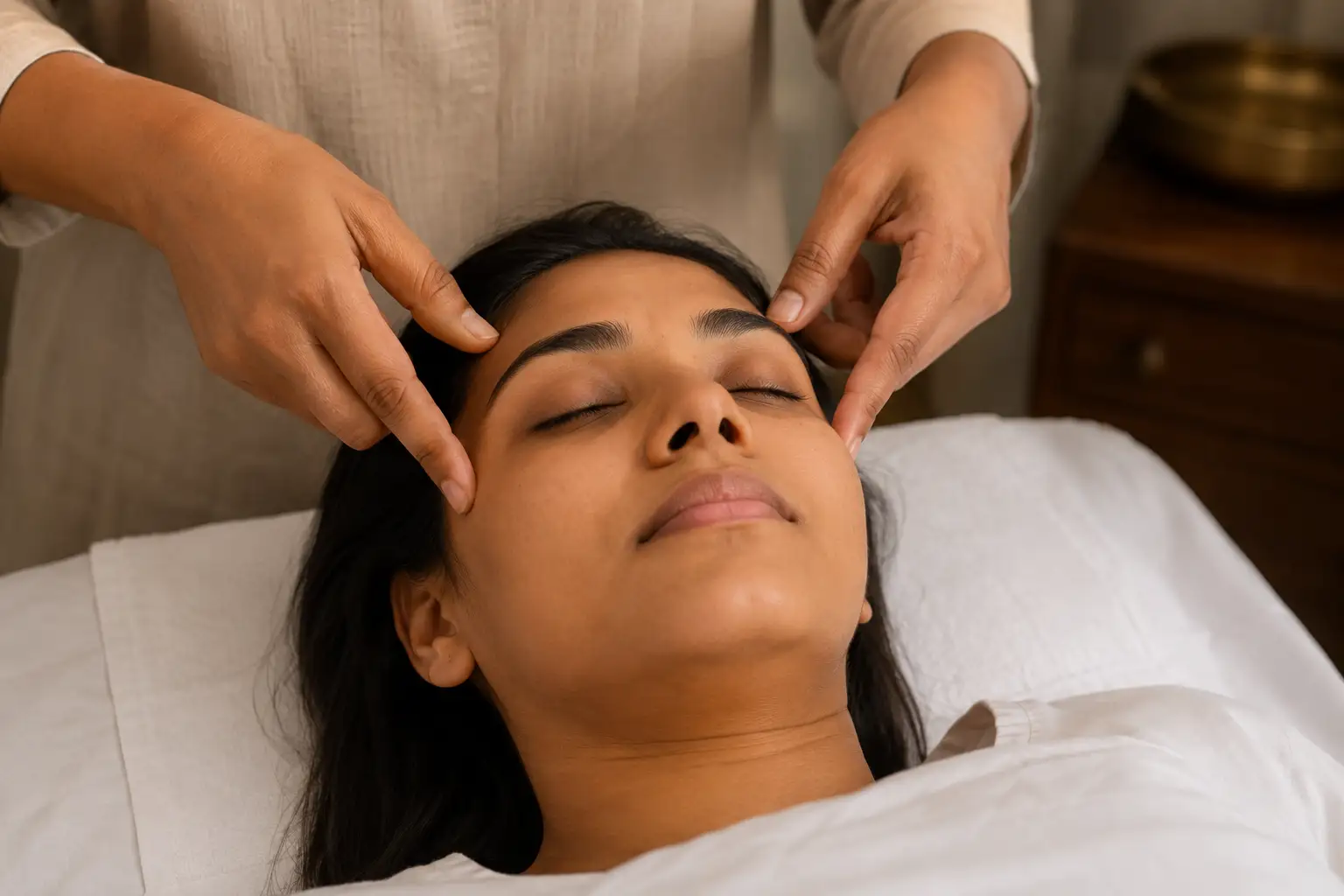
Marma Chikitsa is a traditional Ayurvedic practice that works with specific points known as Marma points.
In the traditional Ayurvedic framework, these points are considered important meeting places of physical structure, sensation and vital energy. A Marma session may involve gentle touch or pressure on selected points, sometimes combined with the application of warm herbal oil.
Marma therapy is different from a deep-tissue massage.
The intention is not necessarily to apply strong pressure or force a tight area to release. Instead, the practitioner works gently and purposefully, allowing the client to become more aware of areas that feel guarded, sensitive, disconnected or tense.
At Ayurhitam, Marma Chikitsa is approached as an individualized Ayurvedic therapy rather than a standard routine applied identically to every client.
Important: Clients should not be encouraged to stop prescribed medication or replace necessary treatment with Ayurvedic products.
How May Marma Therapy Support Desk Workers?
Encouraging a Pause From Constant Stimulation
Desk workers often move directly from one form of stimulation to another.
The work computer may be replaced by a phone, television or another screen. Although the workday has technically ended, the senses continue receiving information.
A Marma session creates a quieter environment in which the individual is not required to analyse, respond, perform or make decisions.
This structured pause may support a subjective experience of relaxation.
Increasing Awareness of Physical Tension
Many people become accustomed to holding tension.
They may not notice that their shoulders are raised, their forehead is contracted or their breathing is shallow until discomfort becomes significant.
Gentle attention to specific areas may encourage the client to recognize these patterns earlier. This body awareness can be valuable because it may help the person make changes during the workday rather than waiting until the tension becomes overwhelming.
Supporting a More Grounded Experience
Digital work keeps attention directed outward—toward screens, messages, data and other people’s requests.
Marma therapy may provide an opportunity to bring attention back to the body. Some clients seek this form of Ayurvedic bodywork because they want a quieter, more focused experience rather than a vigorous massage.
Complementing a Broader Workplace Wellness Plan
Marma therapy should not be used as the only response to an unsuitable workstation or unmanageable workload.
Supportive care may work best alongside:
- Proper desk and monitor positioning
- Frequent changes in posture
- Appropriate movement
- Regular meals
- Screen breaks
- Reasonable work boundaries
- Medical or physical therapy when required
Keep it in perspective: Ayurveda can support a healthier routine, but it cannot make an unhealthy working environment sustainable indefinitely.
What Happens During a Marma Therapy Session?
A practitioner should begin by understanding why the client is seeking therapy.
Questions may cover:
- Where tension is commonly experienced
- How long the discomfort has been present
- Whether symptoms change with movement
- Sleep and energy patterns
- Work schedule
- Digestion
- Stress levels
- Relevant medical history
- Current treatment or medication
- Previous injuries
During the session, the client generally lies or sits comfortably while the practitioner works with selected Marma points using gentle touch, pressure or oil application.
The exact experience varies because Marma Chikitsa should be adapted to the individual. A person seeking general relaxation may receive a different session from someone primarily concerned about feeling disconnected from the body after long hours of concentrated work.
Is Marma Therapy Suitable for Neck and Shoulder Pain?
Marma therapy may be considered as supportive bodywork for some people experiencing mild desk-related tension. However, neck and shoulder pain can have many causes.
Seek appropriate medical assessment if the discomfort:
- Began after a fall, accident or injury
- Is severe or becoming worse
- Travels into the arm
- Is accompanied by numbness, tingling or weakness
- Causes loss of movement
- Is associated with chest pain or breathing difficulty
- Continues despite rest and workstation adjustments
Marma therapy should not delay diagnosis or replace treatment recommended by a licensed healthcare professional.
Building Better Body Awareness During the Workday
The benefits of a wellness session are easier to maintain when the workday also changes.
Try checking in with your body at natural transition points:
- Before opening the laptop
- After finishing a meeting
- Before lunch
- At the end of a major task
- Before leaving the desk
Ask yourself:
- Are my shoulders raised?
- Is my jaw tight?
- Am I leaning toward the screen?
- Have I changed position recently?
- Am I holding my breath?
- Do I need movement, food, water or visual rest?
The goal is not perfect posture throughout the day. The goal is to notice tension early and introduce more variation.
Frequently Asked Questions
No. Although both may involve touch and oil, Marma therapy focuses on selected traditional Ayurvedic points. It may use gentler and more specific pressure than a conventional relaxation or deep-tissue massage.
Marma therapy does not necessarily require strong pressure. The practitioner generally uses controlled, gentle touch based on the points selected and the client’s comfort.
There is no universal number. The recommendation depends on the person’s goals, response to therapy, health history and whether the work habits contributing to the tension are also being addressed.
Marma therapy should not be presented as a cure for neck pain, shoulder pain or another medical condition. It may be used as supportive wellness care after suitability has been assessed.
Ayurhitam offers personalized Marma Chikitsa in Fremont for professionals from San Jose, Newark, Union City, Milpitas and surrounding Bay Area communities. (Contact us)
Reconnect With Your Body After Demanding Workdays
Your body should not have to carry every deadline, meeting and difficult conversation long after the workday has ended. At Ayurhitam in Fremont, Marma Chikitsa is selected and personalized according to your current needs, health history and wellness goals. Schedule a consultation to explore whether Marma therapy may appropriately support relaxation, greater body awareness and a more grounded transition away from work.