
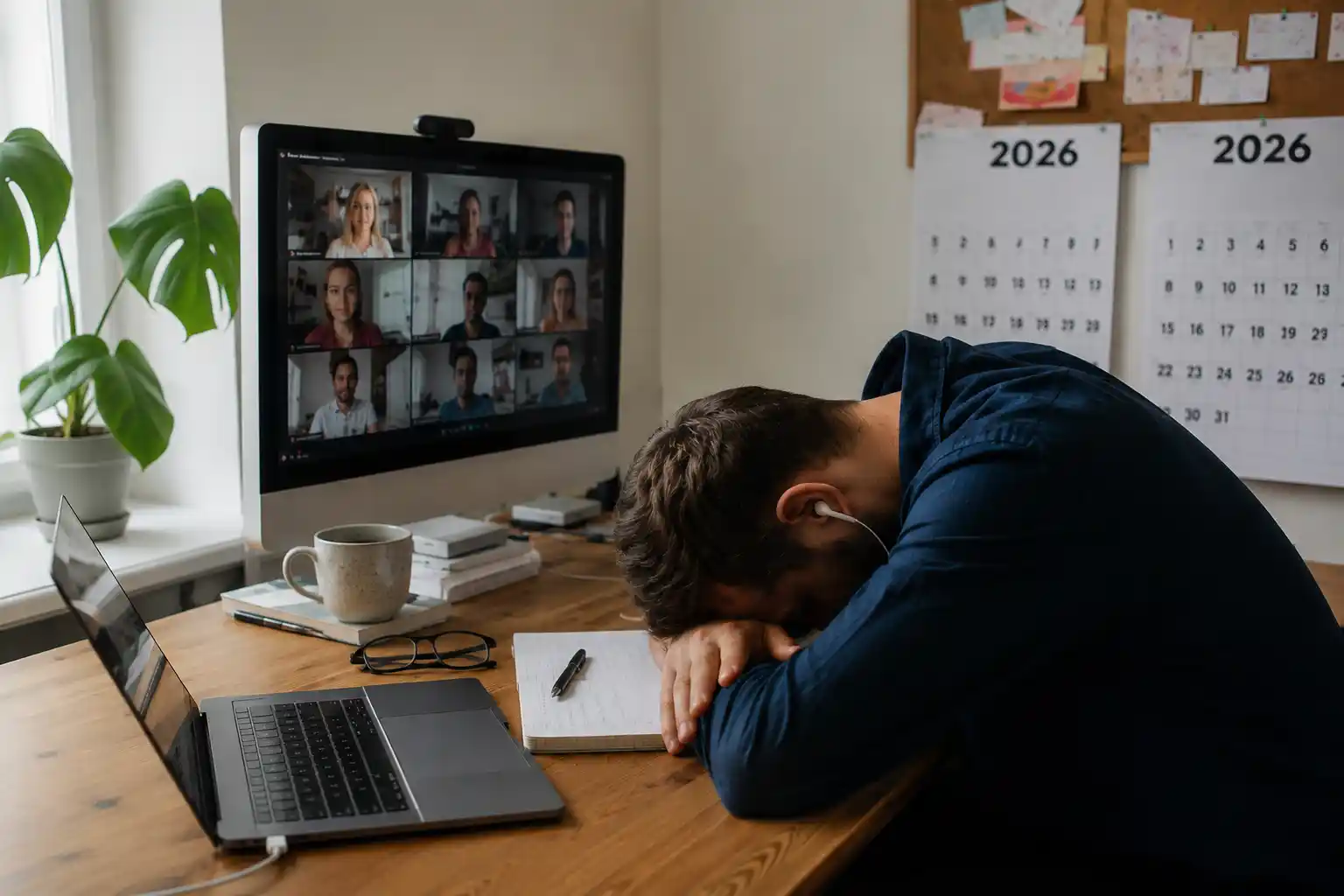
You finish one virtual meeting, close the window and immediately join the next one.
By the end of the day, your body has barely moved, yet you feel as though you have spent hours running. Your eyes feel dry, your shoulders are tight, your thoughts are scattered and even a simple question from a family member feels like too much.
This experience is often called virtual meeting fatigue, video call fatigue or, more casually, “Zoom fatigue.” It does not necessarily mean that you dislike your work or lack motivation. The digital meeting environment can place demands on your attention, senses and nervous system that are different from those experienced during an in-person conversation.
The World Health Organization describes burnout as an occupational phenomenon associated with unmanaged chronic workplace stress. It is characterized by exhaustion, increased mental distance or negativity toward work, and reduced professional effectiveness. Burnout is not classified as a medical condition, and feeling tired after meetings does not automatically mean that you have burnout.
Understanding what is draining your energy is the first step toward creating a healthier and more sustainable workday.
Key Takeaways
- Virtual meetings can demand continuous visual attention, self-monitoring and rapid mental processing, even when you are physically sitting still.
- Back-to-back video calls leave little time for movement, reflection or a mental transition between different responsibilities.
- From an Ayurvedic perspective, excessive screen exposure, irregular routines and constant stimulation may disturb Vata and intensify Pitta-related strain.
- Short breaks, warm regular meals, movement, sensory rest and a clear end-of-work ritual may help restore steadiness.
- Persistent exhaustion should not automatically be blamed on work. Medical, sleep-related and mental-health causes may also need evaluation.
What Is Virtual Meeting Fatigue?
Virtual meeting fatigue is the mental, visual, emotional or physical exhaustion that may appear after extended periods of videoconferencing.
Research into videoconferencing fatigue has identified several dimensions, including general tiredness, visual fatigue, social fatigue, emotional fatigue and reduced motivation. Researchers have also developed a Zoom Exhaustion and Fatigue Scale to study these experiences more systematically.
The exhaustion may appear as:
- Heavy or dry eyes
- Headaches or mental pressure
- Neck and shoulder stiffness
- Difficulty concentrating
- Irritability after meetings
- A desire to avoid further interaction
- Feeling mentally “blank”
- Reduced motivation
- Digestive discomfort from delayed meals
- Feeling tired but unable to relax
The fatigue may become stronger when meetings are tightly scheduled without time to stand, eat, drink water, process information or prepare for the next conversation.
Why Are Virtual Meetings So Mentally Exhausting?
1. Your Brain Is Processing Multiple Faces at Once
During an in-person meeting, you naturally shift your attention between the speaker, your notes and the surrounding room. On a video call, several faces may remain directly in front of you at the same time.
You may also feel pressure to maintain apparent eye contact, monitor people’s reactions and appear attentive throughout the meeting.
Stanford researchers have proposed that close-up eye contact, constant self-view, reduced physical mobility and the increased effort required to interpret nonverbal signals may contribute to videoconferencing fatigue.
2. You Are Constantly Monitoring Yourself
In most face-to-face conversations, you do not watch your own expression while speaking.
During a virtual meeting, your face may remain visible in a small box for the entire call. This can create continuous self-awareness:
- Do I look distracted?
- Am I making the right expression?
- Is my background appropriate?
- Do I look tired?
- Am I appearing engaged?
Even when these thoughts remain in the background, self-monitoring can consume mental energy.
Hiding the self-view window, where the platform permits it, may reduce this unnecessary layer of attention.
3. Your Body Remains Still While Your Mind Stays Alert
Virtual meetings often require people to remain within the camera frame. You may hesitate to stand, stretch, walk or look away because these actions could appear inattentive.
The result is a difficult combination: the body remains inactive while the mind continues processing voices, faces, presentations, messages and decisions.
This may contribute to stiffness, shallow breathing and a sense of restlessness by the end of the day.
4. There Is No Transition Between Meetings
Before remote and hybrid work became common, moving between meeting rooms created small but meaningful transitions.
Walking down a hallway gave you time to breathe, change posture and mentally close one conversation before starting another. Back-to-back virtual meetings remove this buffer.
One meeting may involve performance reports. The next may require conflict resolution. Another may demand creative thinking. Your mind is expected to change direction within seconds, without processing the previous interaction.
This constant context switching can make a day of meetings feel more exhausting than several hours of focused individual work.
5. Your Senses Receive Too Much Digital Input
A virtual meeting is rarely just a conversation.
You may be looking at slides while checking the chat, reading notifications, taking notes and monitoring your next calendar alert. There may be inconsistent sound, screen sharing, multiple speakers and interruptions from other applications.
From an Ayurvedic perspective, this resembles atiyoga, or excessive use, of the senses. The eyes and ears continue receiving information without enough opportunity to withdraw, recover and integrate what has been perceived.
An Ayurvedic Perspective on Virtual Meeting Fatigue
Ayurveda does not diagnose “Zoom fatigue” as a disease. However, it offers a useful framework for understanding how excessive stimulation, irregular routines and insufficient recovery may affect individual well-being.
Vata and Constant Digital Stimulation
Vata is traditionally associated with movement, communication, sensory activity and rapid change.
A workday filled with notifications, changing conversations, irregular meals and continuous screen activity may aggravate Vata-like qualities. A person may experience:
- Restlessness
- Scattered thinking
- Difficulty settling after work
- Irregular hunger
- Light or interrupted sleep
- Dry eyes or dry skin
- Neck and shoulder tension
- Feeling tired but mentally active
The Ayurvedic response is not simply to add another productivity practice. It is to introduce qualities of steadiness, warmth, nourishment and rhythm.
Pitta and Performance Pressure
Pitta is associated with focus, analysis, ambition and transformation.
These qualities support leadership and effective decision-making. However, when work involves constant urgency, perfectionism or pressure to perform, Pitta-like intensity may become excessive.
This may appear as:
- Irritability
- Impatience
- Work-related headaches
- Feeling overheated
- Acidity or burning digestion
- Difficulty tolerating interruptions
- Continuing to mentally analyse meetings after work
The goal is not to remove ambition. It is to create boundaries that prevent focused effort from becoming constant internal pressure.
Agni and Meeting-Driven Eating
Agni refers to the Ayurvedic principle of digestion and transformation.
When lunch is delayed for a meeting, eaten in front of a screen or replaced by coffee and snacks, digestion may become irregular. Some people stop noticing hunger signals until the workday ends. Others eat quickly while continuing to respond to messages.
Over time, this pattern may contribute to heaviness, gas, bloating, acidity or unstable energy.
Ayurveda encourages eating with attention because digestion is influenced not only by what is consumed but also by timing, quantity, environment and the state of the mind.
How to Reduce Virtual Meeting Fatigue
Create a Short Buffer Between Calls
Whenever possible, schedule meetings for 25 or 50 minutes instead of automatically using 30- or 60-minute blocks.
Use the remaining time to:
- Stand and change posture
- Look away from the screen
- Take several unforced breaths
- Drink water
- Write down the next action
- Close the previous meeting mentally
Even a short transition can prevent the entire day from becoming one continuous digital interaction.
Give Your Eyes a Different Visual Distance
Between calls, avoid replacing your work screen with your phone.
Look through a window or toward an object farther away. Allow your eyes to move naturally rather than keeping them fixed at the same distance.
Persistent eye pain, sudden visual changes, severe headaches or ongoing dryness should be discussed with an appropriate eye-care professional.
Protect Your Lunch From Meetings
A working lunch may appear efficient, but it often removes the only meaningful pause in the day.
When possible:
- Step away from the computer
- Sit in a calm location
- Eat at a regular time
- Choose a freshly prepared meal that is comfortable for your digestion
- Avoid discussing difficult work matters while eating
- Allow a few quiet minutes after the meal
Ayurveda does not recommend one universal diet for everyone. Food choices should account for constitution, current imbalance, season, digestion, medical needs and cultural preferences.
Reduce Unnecessary Camera Time
Not every conversation requires video.
Consider whether a meeting could be:
- A written update
- A brief phone call
- An audio-only discussion
- A shared document with comments
- A shorter decision-focused meeting
When video is necessary, hiding self-view may reduce continuous self-monitoring.
Introduce Movement Into the Workday
Movement does not need to be intense to create a transition.
A short walk, gentle stretching or a few minutes away from the desk can help the body shift out of a fixed meeting posture. The movement should be appropriate for your health, mobility and medical guidance.
Create an End-of-Work Ritual
Remote work can make it difficult for the nervous system to recognize that the professional day has ended.
A simple transition might include:
- Closing work applications
- Changing clothes
- Washing the face and hands
- Walking outside
- Sitting quietly without another screen
- Listening to calming music
- Practising gentle breathing
- Spending a few minutes with family before checking the phone
The exact practice is less important than repeating it consistently. Repetition helps create a clear boundary between work activity and personal recovery.
Can Ayurvedic Therapies Support Work-Related Stress?
Ayurvedic care should be selected according to the individual rather than chosen only from a symptom list.
At Ayurhitam, supportive therapies include Shirodhara, Abhyanga and Swedana, and Marma Chikitsa. Ayurhitam describes Shirodhara as a warm herbal-oil therapy used to create a calming and relaxing experience, while Abhyanga and Swedana combine rhythmic oil application with gentle herbal steam. Marma Chikitsa involves the traditional stimulation of specific Marma points.
These therapies should not be presented as cures for burnout, anxiety, insomnia or another medical condition. A qualified practitioner should first assess whether a particular therapy is appropriate for the person’s constitution, current condition and health history.
When Is Exhaustion More Than Meeting Fatigue?
Do not assume that persistent exhaustion is caused only by video calls.
Consult an appropriately licensed healthcare professional when fatigue:
- Continues even during periods away from work
- Is becoming progressively worse
- Interferes with normal daily activities
- Is accompanied by fainting, chest pain or breathing difficulty
- Appears with significant weight changes
- Occurs with prolonged low mood, hopelessness or severe anxiety
- Is associated with loud snoring or disrupted breathing during sleep
- Does not improve despite adequate rest
Immediate professional support is important if you are experiencing thoughts of self-harm or feel unable to remain safe.
Frequently Asked Questions
Virtual meetings may require sustained visual focus, greater self-monitoring and more deliberate interpretation of nonverbal cues. They can also restrict movement and remove the natural transitions that occur between in-person conversations.
No. Virtual meeting fatigue may occur after a demanding day of video calls. Burnout is a broader occupational phenomenon associated with chronic workplace stress, exhaustion, increased mental distance from work and reduced professional effectiveness.
Zoom fatigue is not an Ayurvedic diagnosis, and Ayurveda should not be described as curing it. Ayurvedic consultation may help identify routines, meal patterns, sensory habits and supportive therapies that could promote relaxation and more sustainable daily functioning.
There is no single therapy that is appropriate for everyone. Shirodhara, Abhyanga and Swedana, or Marma Chikitsa may be considered after an Ayurvedic practitioner reviews your health history, constitution, current symptoms and treatment suitability.
Ayurhitam offers personalized Ayurvedic consultations and traditional therapies in Fremont, serving clients from San Jose, Newark, Union City, Milpitas and surrounding Bay Area communities. (Contact us)
Restore a Healthier Rhythm to Your Workday
Feeling depleted after every virtual meeting is not something you need to dismiss as a normal part of professional life. Your meeting schedule, sleep, digestion, sensory load and recovery routine may all be contributing to the pattern. At Ayurhitam in Fremont, a personalized Ayurvedic consultation can help you understand these influences and explore appropriate diet, lifestyle and traditional wellness therapies. Book a consultation to create a steadier, more sustainable routine for your body, mind and working life.