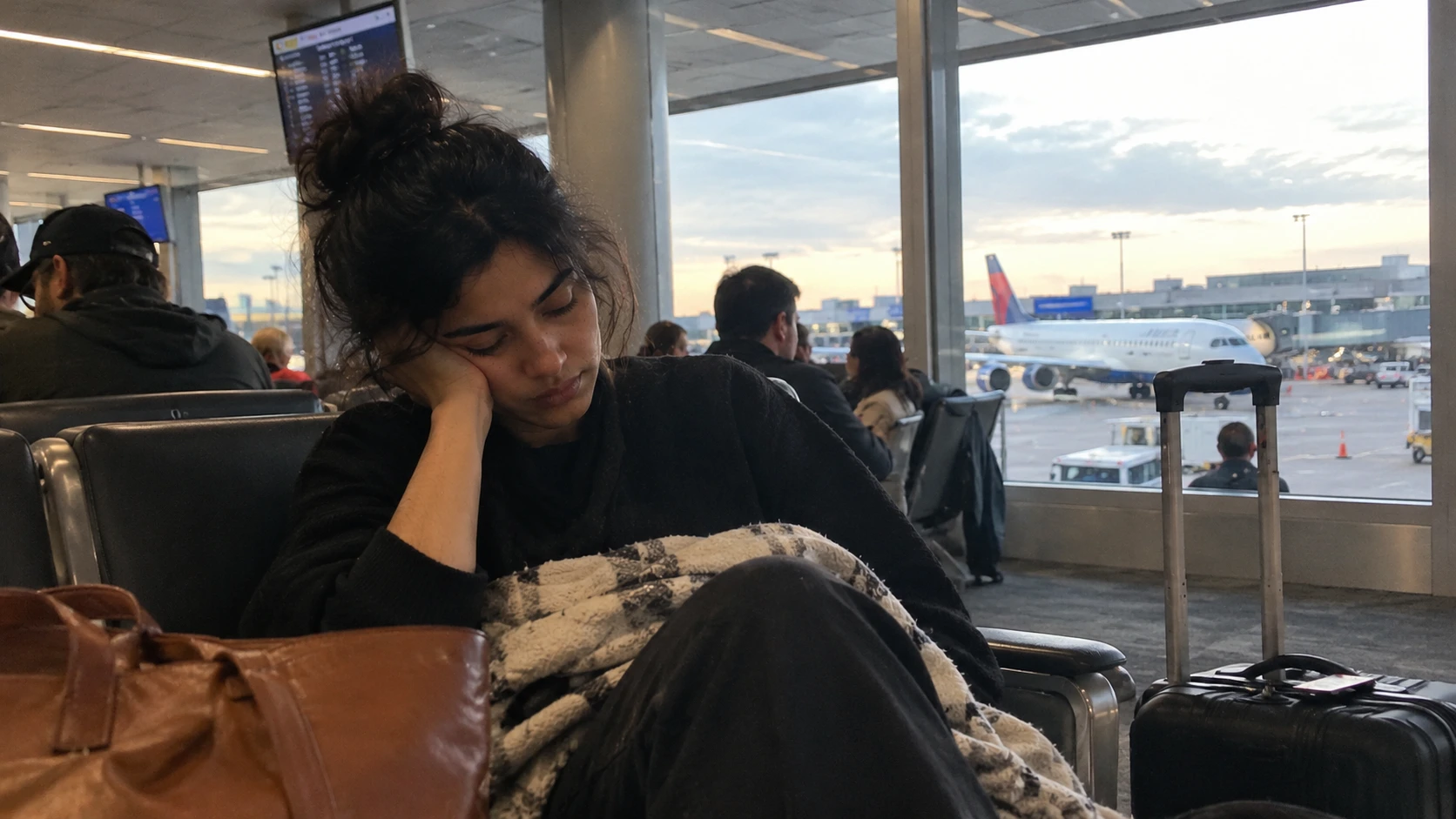
You board a 7 AM flight from SFO to London. Fourteen hours of recycled air, two meals that are not really food, three glasses of wine because the person next to you ordered one, and a window seat you cannot climb out of without waking everyone. You land, hotel, meeting, sleep in snatches. Day three, you are still not sure what time it is in your body. Day five, you fly home. The cycle starts again.
If you are a Bay Area professional who flies for work, you know this rhythm. What you may not know is that jet lag is one of the clearest examples of Vata imbalance in modern life. The Ayurvedic framework for jet lag is more useful than the melatonin-and-blackout-mask approach because it treats the actual mechanism, not just the symptom of disturbed sleep.
Key Takeaways
- In Ayurveda, jet lag is not a sleep problem. It is a classic Vata imbalance caused by air travel, dry cabin air, cold, altitude, and time zone disruption.
- Vata rises with age, which is why jet lag often feels harder after your mid-30s than it did in your twenties.
- The Ayurvedic recovery protocol rests on four pillars: warmth, oil, grounding food, and rhythm restoration.
- Warm sesame oil self-massage before and after flying, warm cooked meals, and a Shirodhara session can meaningfully shorten recovery time.
- For executives flying weekly, a maintenance Ayurvedic protocol is more effective than treating jet lag as an isolated event each trip.
What GLP-1 Medications Do (And Why the Side Effects Follow)
GLP-1 receptor agonists are a class of medications that mimic a gut hormone called glucagon-like peptide-1. They work through several mechanisms:
- Slow gastric emptying: Food stays in the stomach significantly longer. You feel full faster and stay full longer.
- Suppress appetite signals: The hunger drive is dampened at the brain level.
- Improve insulin response: Blood sugar regulation becomes more efficient.
- Reduce food reward response: The pleasure signal from eating is quieter.
These are the signs medication is working as intended. But they are also the exact mechanisms behind the side effects. Food sitting in the stomach for hours longer than normal is why nausea is the most common side effect. Suppressed appetite means many users undereat protein and fibre to the point of muscle loss and constipation. Reduced food reward is why some users describe a general flattening of mood or enjoyment.
Why Jet Lag is a Vata Problem
Vata is the Ayurvedic force of movement, air, and space. It governs your nervous system, circulation, breath, and the natural rhythms of sleep, digestion, and energy. Vata is dry, cold, light, mobile, rough, and clear. Now look at what air travel does to your body:
- Movement: Hours of continuous motion at 500+ miles per hour, often across multiple time zones.
- Dry environment: Cabin humidity sits around 10-20%, lower than most deserts.
- Cold: Cabin temperatures run cold enough to make most passengers reach for a blanket.
- Altitude: Pressurized air at the equivalent of 6,000-8,000 feet reduces oxygen saturation.
- Light disruption: Natural circadian cues are scrambled across time zones.
- Dehydration: The dry air pulls moisture from your tissues at a rate you cannot easily replace.
Every single one of these aggravates Vata. By the time you land, your body is dry, cold, scattered, and disconnected from any coherent daily rhythm. This is what jet lag actually is. The dry skin, the restless sleep, the digestive irregularity, the mental fog, the racing mind at 3 AM in a hotel bed: all of it is Vata rising sharply with nowhere to settle.
Why Jet Lag Hits Harder After 35
In Ayurveda, each stage of life is dominated by a different dosha. Childhood is Kapha-dominant. In general, early and mid-adulthood through about age 50 is Pitta-dominant. Later adulthood is Vata-dominant. This is why Vata-related complaints such as dry skin, disturbed sleep, cracking joints, and chronic anxiety tend to increase as you move through your 30s and 40s.
What this means practically: in your 20s, your Kapha and Pitta reserves masked the Vata disruption of travel. You bounced back in a day. By your mid-30s, those reserves are lower. The same flight that cost you a day of recovery at 25 may cost you three or four days now. This is not weakness. It is a predictable Ayurvedic life-stage shift that the recovery protocol needs to account for.
The Ayurvedic Jet Lag Recovery Protocol
The classical approach uses four pillars. Each one directly addresses one of the Vata-aggravating factors of travel.
Pillar 1: Oil, Before and After You Fly
The single most Vata-pacifying daily practice in Ayurveda is a warm sesame oil self-massage, known as self-Abhyanga. Spend 5 to 10 minutes massaging warm sesame oil into your skin, let it sit for 15 minutes, and then rinse off in a warm shower. Do this the morning of your flight and again the morning after you land. For a deeper reset, book a full Abhyanga session at Ayurhitam within 48 hours of landing.
Pillar 2: Warm, Cooked, Grounding Meals
Vata cannot digest raw, cold, or dry foods well. For the 48 hours after you land, favour warm cooked meals: kitchari, dal, soups, stews, warm cooked grains, roasted root vegetables, ghee, and warm herbal teas. Skip cold smoothies, salads, raw fruit, and ice water. Add ginger, cumin, and cardamom to your food.
Pillar 3: Nasya for the Head and Sinuses
The dry cabin air is particularly aggravating to the head and sinuses, which is why many frequent flyers get sinus congestion, headaches, and mental fog after flying. A simple home practice of putting 2 drops of warm sesame oil (or classical Anu Taila) in each nostril each morning for the three days after you fly can dramatically shorten mental recovery. For deeper support after long flights, a clinical Nasya session at Ayurhitam is one of the fastest ways to clear post-travel head heaviness.
Pillar 4: Shirodhara to Reset the Nervous System
If your travel involves multiple time zones or extended travel, Shirodhara is the most direct Ayurvedic nervous system reset available. A continuous stream of warm medicated oil is poured over your forehead for 30 to 45 minutes. The therapy settles the nervous system in a way that no amount of melatonin or sleep hygiene can replicate. For executives flying weekly, a maintenance Shirodhara every 2 to 3 weeks keeps cumulative Vata damage from building up.
A Practical Protocol by Flight Length
Short domestic flights (under 4 hours, no time zone shift)
- Warm sesame oil on the feet before bed the night before
- Drink warm water on the flight, skip alcohol and coffee
- Warm cooked dinner on arrival
- Normal sleep rhythm, no additional protocol needed
Transcontinental flights (4-6 hours, 2-3 hour time shift)
- Self-Abhyanga before the flight
- Daily Nasya for 2 days after landing
- Warm cooked meals for 48 hours
- 10 PM bedtime for 3 nights to restore rhythm
International long-haul (8+ hours, 5+ hour time shift)
- Self-Abhyanga before and after the flight
- Daily Nasya for 5 days after landing
- Warm cooked meals for a full week
- Consider a clinical Abhyanga and Shirodhara combination within the first week back
- Avoid stacking back-to-back international travel without a 7-day recovery window if possible
Weekly or near-weekly travel schedule
This is where a one-off recovery protocol stops being enough. Chronic Vata aggravation from frequent travel compounds over weeks and months and shows up as insomnia that will not resolve, chronic dry skin, hair fall, joint stiffness, chronic fatigue, and anxiety. Book an initial consultation at Ayurhitam to build a maintenance protocol that includes monthly Abhyanga, biweekly Shirodhara, daily home practices, and dietary support designed for your travel rhythm.
What to Avoid
- Sleep aids as a long-term strategy. They mask the symptom while Vata continues to compound.
- Cold plunges, ice baths, or cold showers immediately after flying. These aggravate the Vata-cold imbalance further.
- Fasting or intermittent fasting on travel days. Vata needs regular warm fuel, especially under stress.
- Raw salads and cold smoothies as the first meal after landing.
- Scheduling a high-intensity workout on the day you land or the day after. Grounding movement like a slow walk is more supportive.
Wellness Disclaimer: Ayurhitam is an Ayurvedic wellness center with locations in Fremont and Sunnyvale, California. The information in this article is for general education and is not a substitute for medical care, diagnosis, or advice from a licensed physician. Statements have not been evaluated by the FDA. Please consult your medical doctor before beginning any Ayurvedic wellness program, and before making any changes to prescribed medications.
Frequently Asked Questions
In Ayurveda, jet lag is a classic Vata imbalance caused by the dry air, cold cabin environment, time zone disruption, and continuous motion of air travel. The symptoms we call jet lag (disturbed sleep, dry skin, digestive irregularity, mental fog, anxiety) are all signs of aggravated Vata dosha. The Ayurvedic recovery protocol addresses the Vata imbalance directly rather than only the sleep symptom.
The classical Ayurvedic jet lag protocol has four pillars: warm sesame oil self-massage before and after flying, warm cooked meals for 48 hours after landing, daily Nasya (warm sesame oil drops in each nostril) for several days after landing, and a Shirodhara session for deeper nervous system reset after longer flights.
In Ayurveda, later adulthood is Vata-dominant, which means Vata-related complaints including jet lag become more pronounced as you move through your 30s and 40s. The same flight that cost you a day in your 20s may cost you several days by your mid-30s. This is a predictable life-stage shift that the Ayurvedic recovery protocol accounts for.
Yes, Shirodhara is one of the most direct Ayurvedic therapies for nervous system reset after travel. A continuous stream of warm medicated oil is poured over the forehead for 30 to 45 minutes, calming the nervous system in a way that no home practice fully replicates. Many frequent flyers at Ayurhitam book Shirodhara within the first week of returning from long-haul trips.
For professionals flying weekly or biweekly, a maintenance Ayurvedic protocol with monthly Abhyanga, biweekly Shirodhara, and a quarterly consultation to adjust the plan is more effective than treating each trip in isolation. Chronic travel aggravates Vata cumulatively, and the maintenance approach prevents the long-term costs of untreated Vata imbalance.
Ayurvedic jet lag recovery is offered at Ayurhitam, with clinic locations in Fremont and Sunnyvale. Call 510-556-3738 to book or discuss a maintenance plan designed for your travel schedule.
Flying Every Week?
Design a travel-recovery protocol that keeps
your schedule sustainable.